
Websites for Transport and Logistics Companies
The person looking for a carrier has a shipment and a deadline. Your website has one job: prove you can move it and make it easy to ask for the price.
The shipper has a deadline, not a curiosity
Nobody browses freight websites for fun. The person on your site has a container that needs to leave Miami by Friday, a car that has to reach Santo Domingo, or a household that is moving next month. They are comparing three or four carriers in one sitting, and the one that answers their questions fastest gets the call.
A transport website earns that call by doing three things in the first screen: saying exactly what you move and where, showing the credentials that make you safe to trust, and offering a quote request that asks the right questions the first time.
Lanes and services, stated like a rate sheet
Freight buyers think in lanes and modes. The site should too. Ocean and air, full container and consolidated cargo, vehicle transport, warehousing and consolidation in the United States, door to door or port to port. Each service gets its own short section with what it includes, what it does not, and the countries or regions you actually serve.
Being precise is what filters your inbox. A shipper whose cargo fits your lanes writes with confidence. One whose cargo does not never wastes an afternoon of quoting.
Trust is the product
In transport, the customer hands you something valuable and watches it disappear over the horizon. The website has to make that feel safe. Registration numbers and licenses near the top. Insurance stated plainly. Years in operation, the ports and airports you work from, and the associations you belong to. Real photos of your warehouse, your trucks and your team, never stock images of a container ship at sunset.
Reviews matter here more than in most industries, because the buyer is often far away and cannot visit. The site links to your Google profile and shows the reviews you have earned.
A quote request built for real shipments
This is where most carrier websites fail. A generic contact form produces a message like "how much to ship to Honduras?" and three emails later someone can finally quote. The form I build asks what a quote needs: origin and destination, what is being shipped, approximate weight or dimensions, the date it has to move, and a field to attach a photo, a packing list or a vehicle title. The request lands on your phone the moment it is sent, with everything in it.
Two languages, written separately
Latin America and the Caribbean trade runs in Spanish, and a shipper in Bogota will not fight through an English page. I build the Spanish and English versions as two real sites sharing one structure, each written for its reader, so a customs broker in Miami and a family shipping a car to Havana both find a page that sounds like it was written for them.
Fast on a phone, because that is where the request comes from
Drivers, dispatchers and small importers live on their phones. The site opens in under two seconds on a mobile connection, the phone number is one tap, WhatsApp is one tap if you use it, and the quote form works with a thumb. That speed is also what Google rewards when someone searches "transporte de carga Miami" or "vehicle shipping to Dominican Republic".
Built and maintained by one person
I build the site from scratch, in both languages, and then I maintain it every month: updates, security, hosting, the domain in your name, and the changes you need when you add a lane or a service. When a customer says the form did not go through, you call the person who built it.
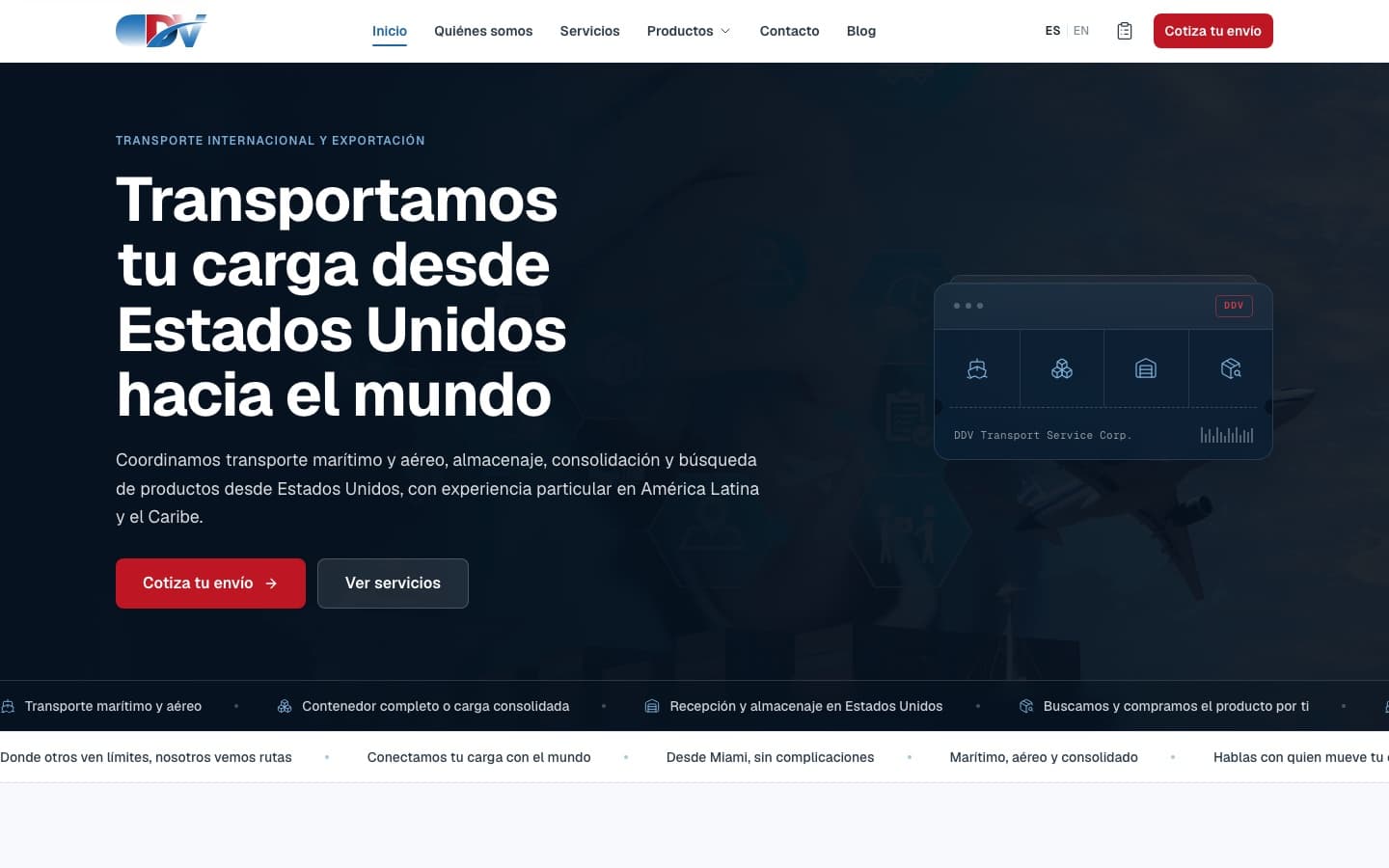
Real work from this industry
Common questions
Can the quote form ask for what a shipment actually needs?
Yes, and it should. Origin and destination, what is being shipped, approximate weight or dimensions, when it needs to move, and a way to attach a photo or a packing list. A form that asks for a name and a message produces a second round of emails before anyone can quote.
We ship to Latin America and the Caribbean. Does the site need Spanish?
If your customers write to you in Spanish, the site should answer in Spanish. I build both versions as real content, not a translation button, so a shipper in Colombia and a broker in Miami each read a page written for them.
Should the site show our USDOT, MC or NVOCC numbers?
Yes. Registration numbers, insurance and the associations you belong to are the first thing a serious shipper checks. They belong near the top, stated plainly, not buried in a footer.
Do we need a tracking portal?
Usually not on day one. Most small carriers track by phone and WhatsApp, and a portal nobody updates is worse than none. The site states how customers get updates, and a portal can be added when the volume justifies it.
Ready when you are
Tell me about your business in four short steps. I reply within one business day.